August 17, 2026 — Old Town’s famed Wacker House, once a pristine landmark at 1838 North Lincoln Park West, is undergoing a tragic and unthinkable “remuddling” that has totally defaced the “Mona Lisa” of Chicago’s rare surviving Victorian-era properties.
Unlike Norma Desmond in the 1950 classic “Sunset Boulevard,” this once-stunning architectural star is no longer ready for her close-up.
In fact, developer and beer baron Frederick Wacker likely would be spinning in his grave today if he toured his once noble 12-room Swiss chalet-style Victorian mansion originally completed in 1874.
The 150-year-old Wacker House received landmark status in 1977 and was officially listed on the National Register of Historic Places in 1984. The historic landmark home later belonged to Frederick’s son, Charles Wacker, who served as chairman of the Chicago Plan Commission for 17 years.
Charles Wacker helped carry out Daniel Burnham’s landmark 1909 Plan of Chicago, championing projects including the widening of Michigan Avenue, expansion of the lakefront park system, and construction of the double-deck boulevard that now bears his name.
Here’s how the Commission on Chicago Landmarks describes Wacker House:
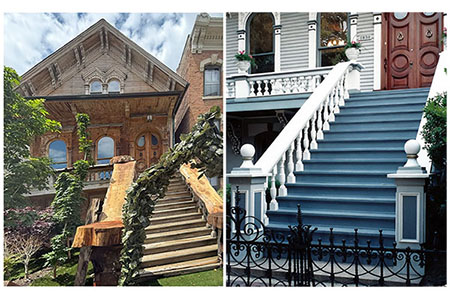
“The unusual house that Swiss-born Frederick Wacker built has a fairy tale quality about it. It has all the characteristics of a Swiss chalet: a wide over-hanging veranda supported by curved brackets, openwork hoods above the windows, and carved wooden spindle railings flanking the broad stairway.”
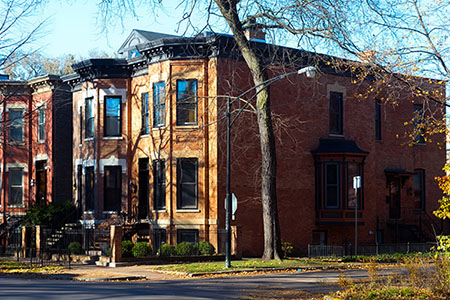
For decades, the street has been a popular residential haven of million-dollar-plus homes coveted by some of Chicago’s top corporate executives.
New owner clueless to history?
Over the past few years, preservationists say the current owner, an apparently clueless New Yorker, has dramatically defaced the historic home’s exterior with the following destructive alterations:
• Protective vinyl siding has been removed, exposing the original vintage clapboard that covers much of the facade. Then, the lead-based paint was stripped off the entire building, including decorative Victorian brackets and irreplaceable railings.
• The once-grand front staircase bannisters now are capped with rough, raw-wood tree trunks that resemble the cabin logs split by Abe Lincoln when he was a youth in Southern Illinois.
• Unsightly circular six-inch-thick log-pancake “caps”—with the circumference of a Weber charcoal grill—replaced the classic, white hardwood ball-shaped crowns on the twin banister posts.
• The vintage two-story brick coach house at the rear of the property has undergone extensive alterations that make it virtually unrecognizable. Decades ago, the coach house featured two living units and a roof deck.
“We are witnessing the intentional harm of an iconic Chicago building,” Hjerpe said.
Here is the text of a harsh report on Wacker House issued by the Old Town Triangle Association (OTTA), the overseer of historic landmark properties in the neighborhood:
“The rich heritage of this iconic Triangle landmark is now threatened. Over the last four years, the house has been altered to an alarming degree. The most noticeable changes are the obvious and inappropriate tree sections clumsily attached to the front stairs and now the back of the building.”
The worrisome preservationist report said: “The most harmful work was done by stripping the lead-based paint off the entire building. The unprotected wood will not last long in Chicago’s climate, and we are in grave danger of losing this priceless exposed woodwork.”
The OTTA said it is unaware of any attempt to obtain city building permits for the work, noting in its report that “in the process of this non-permitted construction, the properties to either side of the property were damaged by unauthorized equipment and lead dust.” The association is urging municipal officials to intervene before more of the landmark’s historic integrity is destroyed.
After years of raising concerns privately, the organization is asking neighbors to report any ongoing work on the property to city officials.
The move follows years of complaints to the Chicago Department of Buildings, which noted that it has issued two stop-work orders at the property since 2023 and responded to multiple complaints in recent years alleging work without permits, alterations to a landmark building, and other construction-related concerns.
Under Chicago’s landmark ordinance, exterior alterations to designated landmark properties and contributing buildings within landmark districts generally require review by the Commission on Chicago Landmarks before permits can be issued.
The rules are intended to preserve the historic character of protected buildings while allowing owners to repair and rehabilitate them in ways that are compatible with the surrounding district.
“While the OTTA respects homeowners’ rights to make changes to their property, those changes must comply with the City of Chicago’s landmark ordinance requirements governing the Old Town Triangle District,” the organization’s members said in a statement.
From 2023 through 2026, the Department of Buildings received 13 complaints related to the property. Complaints included reports of work without plans or permits, paint stripping, alterations to a landmark building, work encroaching onto neighboring properties, construction on the coach house, rooftop work, and jobsite safety concerns.
In June 2025, inspectors issued a second stop-work order after observing construction on top of the property’s coach house, according to the buildings department.
Property records identify the owner of Wacker House as Michael Gancarz. According to Cook County records, Gancarz faced foreclosure proceedings on the property in April 2026, with Bank of Barrington listed as the mortgagee.
Public records also indicate Gancarz was arrested in New York City in 2024 on charges of burglary, petit larceny, and trespassing tied to the unauthorized removal of wine from a luxury shop he previously co-owned, according to the New York Post.
Award-winning history of Wacker House
Wacker House is listed in the American Institute of Architects’ “AIA Guide to Chicago,” a source book of the city’s noteworthy architecture and landmark properties.
Winner of the 1990 Chicago Sun-Times “Painted Lady Award,” Wacker House has been listed for sale and sold four times over the past three decades.
Former owner Mrs. Maurice Forkert recalled the home’s rich history when interviewed at age 89 in 2001 by listing broker Sara Benson of Benson Stanley Realty. After moving into Wacker House in the 1960s, she went on to help lead the landmarking of the Old Town Historic District in 1977.
“Old Town was an exciting place to live in the 1950s and 1960s when many of the residents were artists, writers, and graphic designers,” Mrs. Forkert recalled.
Swiss-born Otto Maurice Forkert, a graphic designer, purchased Wacker House in 1950, and resided there with his first wife, Louise. He ran his business in the two-story coach house. Later, the rambling main house was divided into three rental apartments.
“After Louise died in 1958, Maurice purchased the adjoining home at 1836 Lincoln Park West, and we married in the early 1960s,” Mrs. Forkert recalled.
The Forkerts shared a love of architecture and gardening. “Maurice served on the board of the Landmarks Preservation Council. Together they worked to preserve the vintage architecture of Old Town and fought teardowns,” she said.
“Wacker House’s architecture is so striking that architecture buffs can be seen photographing it almost daily,” said Benson. “In 2001, the home’s lushly landscaped front gardens were accented with an attractive fountain topped with a statue of the Greek goddess Diana.”
A sweeping, ornate grand staircase led to the third-floor bedrooms. French doors opened from the master bedroom to a trellised 14-by-11-foot private deck with a view of Willis Tower and St. Michael’s Church.
Situated on an oversized, L-shaped lot—measuring 33 feet of frontage by 125 feet deep, plus a 50-foot width at rear—the main residence consisted of five bedrooms and four-and-a-half baths housed within approximately 4,700 square feet of living space. The original 1,800-square-foot brick coach house was substantially demolished in recent years. Now only one room and a roof deck exist, along with a four-car garage below.
The Old Town Triangle Association asks readers and neighbors to share any new construction activity at Wacker House so the organization can document it. Email to: hdoz@oldtowntriangle.com.
Unlike the hidden, rotting portrait in the 1945 film “The Picture of Dorian Gray,” the ongoing destruction of this 150-year-old Victorian gem is taking place in broad daylight.