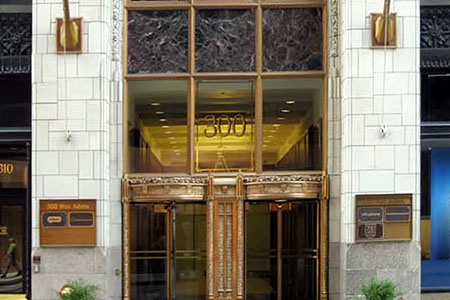
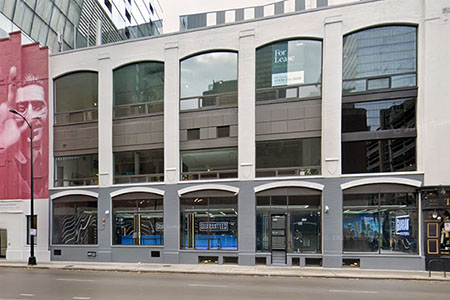
(Above) Chicago Joe’s saloon in 2019.
November 6, 2025 – As classic 16-inch Chicago-style softball teams mourn the loss of Chicago Joe’s – the memorabilia-filled restaurant and nostalgic, museum-decorated saloon in the North Center neighborhood – the City of Chicago has issued a building permit for the apartment building that will replace it.
Landrosh Development will erect a 38-unit masonry apartment building on the long-vacant northeast corner of Irving Park Road & Oakley Avenue at a projected cost of $7.7 million. Real estate records show that the developer purchased the property for $1.85 million in July 2022.

|
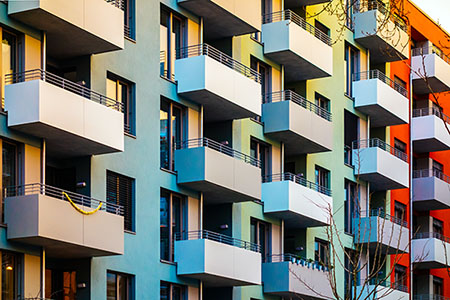
(Left) Rendering by SGW Architecture & Design of the apartment building planned for 4009 North Oakley Avenue. |
Residential units, eight of which will be set aside as affordable housing, will occupy the upper four floors and feature balconies and outdoor terraces. The first floor will include 2,800 square feet of retail/commercial space. A garage accessed off Oakley will provide 19 parking spaces and storage for 42 bicycles.
Hopefully, the developers will attract a Chicago-style softball saloon to fill one of the future commercial spaces, but the retail offerings likely will go to a high-end restaurant.
|
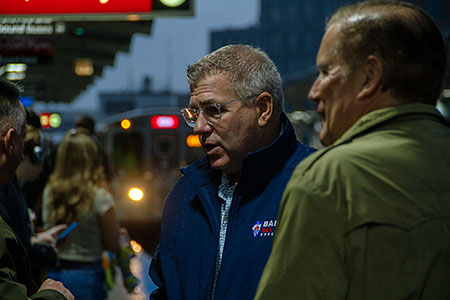
“The planned development is a stone’s throw from the upscale St. Ben’s neighborhood, where homes priced at $2.6 million to $3.4 million are currently listed for sale,” noted North Side broker Sara Benson (right), president of Benson Stanley Realty. |

|
Although it appears the site likely will have a happy ending after sitting vacant for more than three years, where would 16-inch Chicago-style softball be without a faithful and loyal sponsor – a neighborhood saloon like Chicago Joe’s?
North Side softball players still share more than three decades of sports memories celebrating dozens of championships and a few sad defeats at Chicago Joe’s.
Dozens of happy male-female social interactions occurred over a glass of wine, a Hennesy cognac, or Grey Goose on the rocks, and there always was stimulating conversation. This writer, who pitched and managed the Risk and Vintage Risk teams, sponsored by Chicago Joe’s for more than 30 years, met his beautiful, brainy, and wonderful Realtor wife at the bar in 1992. Our relationship has lasted 33 years and is going strong.

|
“Spirits of good times still reside on the corner that once was Chicago Joe’s,” reminisced Dean Karouzoz (left), who pitched for Risk. “The new apartment renters will feel happy vibes there.” |
Veteran Chicago softball team managers might jokingly tell you losing a good sponsor is worse than losing a wife. While that’s probably not true, for decades, thousands of teams have courted sponsors at the corner saloon, the nearby funeral home, auto agency, realty office, or the pizza parlor down the block.
Celebrating at the sponsor’s saloon after a good game is part of the legend of Chicago softball. Every softball team is looking for the sports-minded businessperson who would like a guaranteed increase in business. They don’t mind putting up a few hundred dollars for a league entry fee and some lettered cotton T-shirts. Often, the saloon owner/sponsor played on a competitive neighborhood softball team as a youth and still has a love for the game.
Perhaps retired 16-inch softball players should apply for a few of those affordable apartments offered at 4009 North Oakley. They earned the right by consuming 8,000 gallons of beer on-site.
A saloon for average Joe’s
In the early 1980s, I met Polish-American saloonkeeper Al Rompza while playing handball at the Irving Park YMCA. In 1988, Rompza purchased the old Grover’s Oyster Bar at Irving Park Road & Oakley Avenue and renamed it Chicago Joe’s.
“My place was designed to appeal to the average Joe – any neighborhood guy,” said Rompza.
A wily, intelligent entrepreneur, Rompza made sure to offer sponsorships to his sports teams, including my “Solidarity” team in 1979. We won a 1980 championship in the tough Kosciuszko Park league on Diversey near Pulaski.
Chicago Joe’s once was such a softball mecca it sponsored teams virtually every weeknight.
|
“Years ago, one of our female bartenders played 16-inch softball on five teams,” recalled Brad Rompza, Al’s son, who managed the saloon. (Right) Brad (third from left) with his father, Al (far right), and other family members. |

|
In 1985, the Solidarity team was reorganized, upgraded, and renamed “Risk,” after my son Erik’s youthful graffiti tag. Erik, a speedy outfielder who still runs in the Chicago Marathon, joined the team and we expanded our play to two or three nights a week.
Later, Herb, my youngest son, also played for Risk, and hit a lofty .600 one season at Oz Park. Risk and its successor, Vintage Risk, went on to win more than 30 championships over 32 years while sponsored by the saloon.
Chicago Joe’s celebrated its 30th anniversary in business in 2018, noted owner A.J. Rompza, Al’s youngest son, who still manages The Burwood Tap, a Lincoln Park saloon at Wrightwood Avenue & Burling Street. The Burwood Tap is a family-operated watering hole that was passed down over three generations from Rompza’s grandfather.

|
Over 38 years, both of Rompza’s sports bars have sponsored the Risk and Vintage Risk teams, and their predecessor, Solidarity. (Left) Don DeBat (far left in photo) and the rest of the Solidarity softball team in 1984. |
With future Hall of Famer Al Placek and the great Gary Bergner in the infield, and other AA players on the roster – including stars John Clausen, Keith Dickens, and Bob Egan – Vintage Risk won six championships at Horner Park and Trebes Park in 2014, 2015, and 2016. It was a rare six-peat run not repeated by many Chicago 16-inch softball teams.
Earlier, in the late 1980s, the original Risk team – with the late Sal Ganir pitching, the legendary Jim Fuller of the Dwarfs on the roster, and Keith Dickens of the Chicago Jets in center field – also won six championships on Tuesday and Thursday night leagues in the tough Hamlin Park “A” bracket. Risk, then rated as a good “B” team, beat several AA teams on the way to championships in 1987, 1988, and 1989 – yet another rare three-peat.
|
Both Ganir and Fuller are Hall of Fame inductees. (Right) Championship softballs on display at Chicago Joe’s. |

|
For decades, Risk teammates always held their victory parties washing down buckets of jumbo chicken wings and oysters on the half shell with pitchers of beer in Chicago Joe’s outdoor garden.
Polish social movement inspires team name
Back in 1979, when the Burwood Tap first started sponsoring the Solidarity team at Trebes Park, Al Rompza asked the manager (this writer) why his team was named after a social movement in Poland?
The answer was the roster was filled with great Polish, Czech, and Ukrainian-American players with names like Tony Dudek, Bob Gorzynski, Joe Oleksy, Glen Placek, Mike Skowronski, Paul Sortal, and Steve Wysocki.
In the early 1980s, Rompza opened the Ultimate Sports Bar, a saloon on the corner of Armitage Avenue & Sedgwick Street in Old Town that showcased a real boxing ring. Rompza’s partner, saloonkeeper Jimmy Rittenberg, owned Juke Box Saturday Night on the nearby Lincoln Avenue saloon strip.
With Solidarity playing at Oz Park a block away, it made sense to hold the post-game festivities – including Jitterbug and Twist contests – at Juke Box Saturday Night, while platters were spun in the interior of a chopped 1957 Chevy convertible.

|
Besides our softball team’s perennial winning record, the best 1950s platter spun by the disc jockey was At the Hop by Danny & the Juniors. (Left) Vintage Risk players at Chicago Joe’s around 2015. |