March 24, 2025 – The Cook County Assessor’s job is hugely important – overseeing the nation’s largest property tax system with more than 1.9 million real estate parcels that must be valued.
However, a recent investigation by the Illinois Answers Project and Chicago Tribune identified hundreds of mistakes caused by misclassified and undervalued properties, mostly centered on new or renovated properties during the 2023 tax year.
In some cases, Cook County Assessor Fritz Kaegi’s office assessed mansions as vacant lots and missed assessing the bulk of two new subdivisions in a far south suburb. Kaegi’s office quickly moved forward with an internal audit that eventually revealed that even more properties were improperly classified.
Over the past several months, the Assessor assigned staffers – including the top official overseeing data integrity – to sharpen office assessment processes that previously resulted in inaccurate tax bills and hundreds of millions of dollars in missed value that should have been taxed.
Apparently, the misclassification issues mostly revolve around building permits, and failure to patch holes in the office’s databases. In hundreds of cases, Kaegi’s office had construction permit records on file but failed to follow up with or modify assessments with the new information.

|
“These changes are central to our ongoing work to modernize our operations, make our own work more efficient, and ensure that the property tax system is fair and accessible for all Cook County residents,” said Assessor spokesperson Christian Belanger (left). |
Kaegi elected to fix a flawed Assessor’s office
Kaegi, a reformer, was elected to the job in 2019 after defeating longtime Democratic machine stalwart Joseph Berrios.
Critics say Berrios’ loose-cannon assessment style often sidestepped fairness and focused on well-heeled insiders along with politically connected tax-appeal lawyers. Favorable valuations allegedly were handed out to wealthy downtown property owners who kept donations flowing into Berrios’ campaign coffers.
While nepotism and patronage ran rampant, and ethics rules were ignored by Berrios, Kaegi ran on a pledge to overhaul Berrios’ dysfunctional office, and voters believed him. On the whole, Kaegi has delivered.
Kaegi inherited not only a deeply flawed, ethically bankrupt office, but also a dusty, decades-old data system that relied on reams of paper. When Kaegi first took office, his staff allegedly found 600 tons of paper tax appeals in storage.
|
Immediately, Kaegi launched a plan to modernize the office’s data system, replaced most of Berrios’ top staffers, and halted the office’s practice of accepting campaign contributions from tax-appeal lawyers. (Right) Fritz Kaegi |

|
Kaegi refocused assessment efforts on the fat cats to give relief to homeowners who have been carrying the majority of the tax burden for decades.
The International Association of Assessing Officers presented Kaegi’s office with its Outstanding Public Information and Outreach Award, and the National Association of Counties gave his office an award for its digital innovation efforts.
Assessor Kaegi is a highly qualified expert in property assessments, holding both the Chartered Financial Analyst and Certified Illinois Assessment Officer designations.
Kaegi probably is the most honest Cook County Assessor we have ever had, based on this reporter’s opinion, after covering the office for 57 years.
Before serving as Assessor, Kaegi had a 13-year career as a financial asset manager at Columbia Wanger Asset Management. Born and raised in Chicago’s Hyde Park neighborhood, Kaegi holds an MBA from Stanford University.
Over the decades, this writer has covered real estate assessment trends while the Assessor’s office was headed by a diverse collection of mostly Irish-American Democratic-machine creatures – including P.J (Parky) Cullerton, Thomas M. Tully, Thomas C. Hynes, and James Houlihan. The ancient Cook County Assessor’s office has existed in its present form since 1932.

|
(Left) P.J. Cullerton (at right in photo) in 1954 when he was a Chicago alderman. |
Property details are not being updated
While “patching holes” in the Assessor office’s databases, let’s not ignore the elephant in the room. Every property in the Cook County Assessor’s system also comes with detailed property characteristics – facts about lot sizes, square footage of interior space, and number of bedrooms, bathrooms, fireplaces, and garages.
The truth is, over the years, few if any of these property characteristics have ever been updated. In many cases, the information is inaccurate, and in some cases probably caused the property’s assessment for many owners to be too high, leading to decades of over-taxation.
The Home Front conducted its own survey of a collection of North Side buildings to check errors in the Assessor’s property characteristics. Here’s what our investigation learned:
|
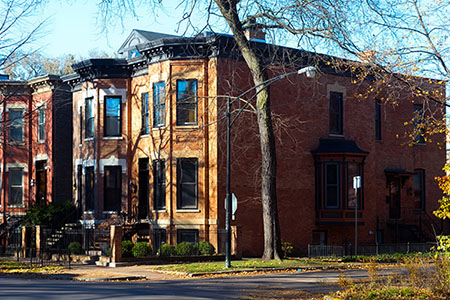
Old Town. A vintage multi-family apartment property is being over-assessed for having a 3.5-car garage. Not only does the property not have a garage, it doesn’t even have an alley. (Right) Homes along Orleans Street in Chicago’s Old Town neighborhood. |

|
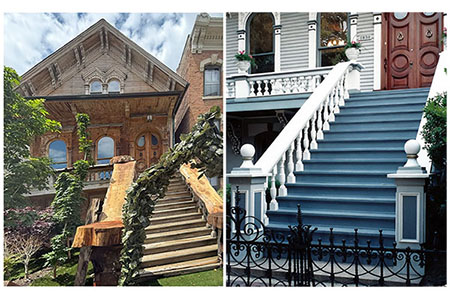
Lincoln Park. The owner of a Victorian three-flat was surprised to learn that the Assessor lists his building as a five-flat, with 11 bedrooms and nine bathrooms. The building only has five bedrooms and five-and-a-half baths.
In addition, the Assessor’s characteristics show 4,822 square feet of interior space. The apartments have 1,100 square feet each, meaning the total square footage is about 3,300 square feet – a whopping 31 percent error in mystery space.
And, the senior citizen owner applied for a Senior Exemption, but the Assessor did not grant one even though the property owner is over the age of 65.
North Lincoln Square. According to the Assessor, this four-flat has a two-car brick garage. That was true 40 years ago. However, after a City of Chicago construction vehicle backed into the garage and structurally damaged it, the city ordered that the garage be razed.
Regardless, 40 years later the Assessor still lists the non-existent two-car garage under the property’s characteristics. And the “invisible garage” is still listed on the Assessor’s “property characteristics,” likely causing the property tax bill to be higher.
So, how did the Assessor’s property characteristics on some of these properties become erroneous?
Experts say during Chicago’s post-World War II housing shortage, especially in old inner-city neighborhoods such as Old Town and Lincoln Park, often small apartment buildings were subdivided into additional living units. Kitchens and bathrooms were added, often without building permits being issued.
With little or no post-war building code enforcement, a three-flat could easily be transformed into a seven-flat, sometimes without separate front and rear entrances.
During this late 1940s era, a one-bedroom apartment would rent for $20 a month, historians say. The rent sounds ridiculously low, but the average worker back then earned about $50 a week.

How to check property characteristics
Homeowners seeking to verify the Assessor’s facts about their property should visit www.cookcountyassessor.com.
- Hit “Property Search” and type in your home or apartment building’s Permanent Index Number (PIN) or address.
- Scroll down to “Characteristics” and double check that the Assessor has the correct facts.
- For multi-family properties, check the number of apartments, number of bedrooms and bathrooms, and the building’s square footage of living space.
- Does the property have a garage?
- Then click on “Exemptions,” and make sure your property has a Homeowner’s Exemption. If you are over the age of 65, you also should have a Senior Exemption.
- If any information is erroneous, apply for a Certificate of Error.