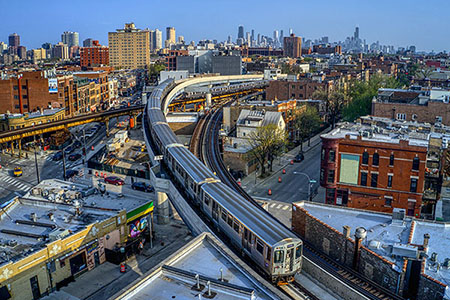
(Above) Northwest bridge house of the Lake Street Bridge. Photo by Jim Phillips.
November 4, 2016 – The “100 Club” for Chicago River bridges is getting less exclusive. The newest inductee is the West Lake Street Bridge, rolling over the century mark on Sunday.
The club now has ten members and of those, six are still in operation.
One hundred years ago, the world’s first double-decked trunnion bascule bridge opened in stages at Lake Street. L trains crossed the upper deck on March 4. Street cars crossed the lower deck on October 15. The project was complete when pedestrians and automobiles first crossed on November 6.
The current bridge replaced a double-decked center pier swing bridge that rotated to let ships through. All swing bridges in Chicago had been identified as obstructions to navigation and were ordered removed by the United States War Department in the late 1800s. Replacing the swing bridges was a decades-long process, with the last Loop swing bridge, at Clark Street, removed in 1929.

|
(Left) In this photo of the Lake Street Bridge that appeared in the 1915 annual report of Chicago Public Works, the old swing bridge is still in place while the new bascule leaf bridge is under construction. The new bridge was built around the existing swing bridge with the bascule leaves in the vertical position.
Once the leaves were finished, the swing bridge was rotated open, carved up, and floated away on the river. The bascule leaves were then lowered into place and the railroad deck was completed. (Click on images to view larger versions.) |
When it came time to replace the Lake Street swing bridge, the operators of the Chicago & Oak Park Elevated Railroad, which used the top deck of the bridge, were concerned about construction delaying their rail service. Chicago Public Works engineers looked at various options to minimize the impact and determined the best approach was to continue rail traffic across the existing bridge while the new bridge was built.
But when bids were opened, they all exceeded the amount appropriated for construction of the new bridge. Scherzer Rolling Lift Bridge Company, Strauss Bascule Bridge Company, and Strobel Steel Construction Company all claimed their bridges would be better and less expensive than the city’s initial design.

(Above) View looking southeast toward Lake Street Bridge. Photo by Jim Phillips.
In response to these claims, the Finance Committee of the Chicago City Council created a three-engineer commission charged with evaluating competing bridge designs. The council appointed city engineer John Ericson and J.E. Greiner, consulting engineer for the elevated railway. A third member, W.H. Finley, chief engineer of the Chicago & North Western Railway, was selected by the appointed members.
Three competing designs emerged – a vertical lift bridge, a single-leaf trunnion bascule, and a double-leaf trunnion bascule. Although the vertical lift bridge was chosen by the engineer commission, as the double-leaf trunnion bascule was more in tune with the aesthetic ideals of the 1909 Plan of Chicago, its advocates lobbied and won.
After the design was revised to make the project more economical, construction contracts were awarded in March 1914, with substructure work beginning almost immediately.
| (Right) Tour boats and an L train pass under and over the Lake Street Bridge in 2012, before recent development of Wolf Point. Photo by Steven Dahlman. |

|
The elevated rail traffic was stopped on the old bridge on Sunday, February 27, 1916, and resumed on the new bridge six days later on March 4. Street car traffic resumed on October 15. Automobile and pedestrian traffic was interrupted for the entire construction period and resumed on November 6.
This is the fifth bridge in approximately 165 years at this river crossing and it is the longest-serving, a testament to the Chicago engineering team that developed and refined the Chicago-type bascule trunnion bridges and the Chicago Department of Transportation team that operates and maintains them.

|
(Left) Recent photo of construction involving the northeast bridge house. Photo by Bob Johnson. |