|
Architect’s son sees restoration in Marina City’s future
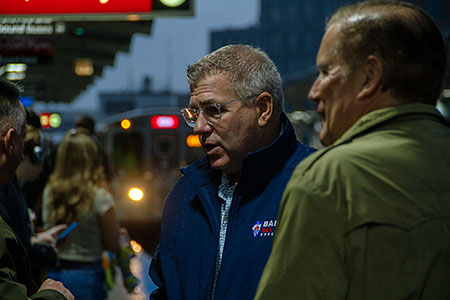
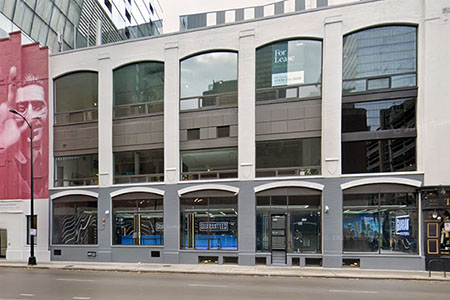
January 12, 2008 – He may have only been four years old when planning for Marina City started in 1959, but Geoffrey Goldberg has had a front row seat at Marina City ever since. He was there at the groundbreaking ceremony on November 22, 1960, along with his father, Marina City architect Bertrand Goldberg. He remembers a lot of energy at the groundbreaking, and an optimistic “euphoria” of the times. Planners and builders of Marina City were embarking on a $36 million project that in today’s dollars would be worth $252 million. Goldberg says he doesn’t think too far into the future of Marina City, but he does believe it will come full circle. “In my heart of hearts, I believe there will be a day in which Marina City will be restored to what it was. I go to sleep at night and hope that’s the case.” What would it take to do this? Goldberg says the theatre building – now occupied by House of Blues Chicago – and the office building would need to remain as centerpieces to the Marina City complex, but the views across the complex to the river would have to be restored. Over time, this would mean restoration of the glass walls on the first floors of the office building, and putting the plaza back to use for people, not just cars. The two-tone exterior paint colors, he says, would have to be cleaned up. “The buildings are concrete, pure and simple. No two-toning!” Says Goldberg, “It would require some sympathetic ownership. For whatever reason – it’s a very curious thing – but these most radical buildings are unheralded except by the people – they get it. Why don’t the owners?” One of the historical mysteries of Marina City is the main influence of the radical cylindrical design. There are a few theories. Goldberg as well as other architects had designed other cylindrical buildings, including an apartment building by Chinese-American architect I. M. Pei that was actually built in 1949. But Geoffrey has his own theory. In 1952, his father completed work on a design for a railroad car. Because of a steel shortage, the challenge was to design a rail car that used steel more efficiently. According to Geoffrey’s own research into his father’s work, Goldberg created a “monolithic tube-like structure” made of layers of strong plywood. The plywood was then laminated under heat with special plastics.
“I believe the boxcar done in the early 1950s was for my father the real structural breakthrough. It is a tube structure. And put that together with the use of curved concrete in a later project – work in the mid-50s for a sewage plant in Nashville – and it’s not too far to get to a vertical tube, the concrete core, at the heart of the towers at Marina City.” The cylindrical design is more wind-resistant. It’s believed the residential towers have only 30 percent of the wind resistance they would have if they were of a more conventional rectilinear form. Goldberg is an architect with offices in the River North neighborhood. He was interviewed for the Marina City history project, “City Within A City.” |


|

Serving the Loop and Near North neighborhoods of downtown Chicago