November 10, 2026 — Even though more than eight decades have passed since the end of World War II, on Veterans Day every American should look back in time and honor those who served in our armed forces during the last “good” war.
Between December 7, 1941, and September 1945, more than 16 million Americans served in World War II. As a “World War II baby” born in 1944, I am proud of the family members, friends, and those vets I worked with and greatly respected. Those veterans served in the biggest and greatest war planet earth has experienced.
While Hollywood movies romanticize the era, real war is about endless battle stress, fatigue, bad food, and being bitten by snakes, mosquitoes, and contracting malaria.
Hundreds of thousands of American veterans died or were seriously wounded doing that deadly work, at a salary of $2 or $3 a day. Overseas, a buck-Private’s net annual pay was $45 a month, or $540 a year (the equivalent of about $11,600 today). A Sergeant pocketed $78.78 a month, or $943 annually (roughly $20,200). A higher-ranked Staff Sergeant earned $110.16 a month, or $1,202 a year overseas (about $25,700).
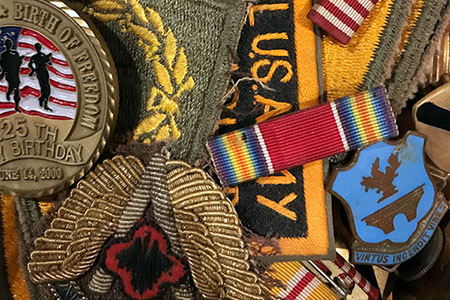
In World War II, U.S. combat deaths totaled 407,316 in Europe and the Pacific, and another 671,278 casualties were listed as wounded in action. Survivors earned a Purple Heart, and most earned occupation, campaign, and victory citations.
A soldier gives his courage, his commitment, and years of his life to protect the freedom of his children, family, and future generations he will never meet.
Chicago Daily News warriors
Now, on Veterans Day in 2026—some 85 years after the official beginning of World War II—it is time for readers to review a few of the heroic stories of Chicago military veterans I knew as co-workers in the newspaper business over decades. Here are their stories:
In 1968, this writer first met several World War II old-timers while working as a reporter on the staff of the Chicago Daily News. They were hard-drinking, cigarette-smoking combat veterans who typed news stories with two fingers and rarely said a word about their war experiences.
Robert (Bob) Schultz, always cool under deadline pressure, was a bomber pilot on a B-25, the twin-engine bomber featured in the 1942 raid on Japan by General Jimmy Doolittle in Twenty Seconds Over Tokyo. Schultz flew 32 successful combat-bombing missions over Europe and was decorated with the Distinguished Flying Cross and the Air Medal with three clusters. He worked for the Daily News for 27 years as a reporter, chief political correspondent, and City Editor. He passed away at age 66 in 1989. One of his daughters, Susy Joan Schultz, proudly followed her father into journalism as a Chicago Sun-Times reporter.
William (Bill) F. Mooney was the “Old-School” man of the rewrite desk. Mooney kept a bottle of Jack Daniel’s whiskey in his drawer for a post-deadline snort in his coffee, smoked constantly, and was respected as the fastest rewrite man of his time. In 1940, Mooney enlisted in the Canadian Army Infantry, later transferred to the U.S. Army Air Corps, and served 54 months as a B-17 tail gunner. In 1943, his bomber was shot down over Germany, and he spent 22 months imprisoned in Stalag 17. In 1957, Mooney, Schultz, and a team of Daily News reporters won a Pulitzer Prize for an investigative series on state political corruption. He passed away in 1985 at age 66.
John Justin “JJ” Smith, a Bronze Star winner and Purple Heart recipient, worked at the Chicago Daily News as Assistant Sports Editor and Travel Editor. A quiet Southwest Side family man, Smith served in the South Pacific with the 41st U.S. Army Infantry.
He passed away at age 70 in 1989. His son, Tony Smith, recently published his wartime manuscript as the book Jungle Scouts.
Herbert Lankford Benson, Jr. graduated from the University of South Carolina at age 18 in October 1944. A gifted photographer, he enlisted in the U.S. Army and served in the Philippines under General Douglas MacArthur. He flew behind enemy lines as a combat photographer, built a darkroom at headquarters, and developed Tri-X film for MacArthur.
Howard M. Busk joined the U.S. Marines in 1935 at age 18 and was stationed at Pearl Harbor on the USS New Orleans. After the outbreak of World War II, he re-enlisted in the 5th U.S. Marine Division, rising to Staff Sergeant.
His daughter Celeste Busk had a successful career as a features reporter for the Daily News and Sun-Times.
Alfredo P. Acierto, a Filipino immigrant and U.S. Postal Service clerk, enlisted in the U.S. Navy when World War II broke out. He served in Transport Squadron 17 during the Philippine Liberation and became the Navy Commander’s personal aide.
Acierto returned to Chicago, raised his family, earned a degree from Northwestern, and passed away in 2008 at age 104 with full military honors.
“Jungle Scouts” — Behind enemy lines in World War II
Jungle Scouts is a chilling and insightful book authored by Bronze Star winner and Purple Heart recipient John Justin Smith about his behind-the-lines World War II service tracking enemy troop movements in New Guinea.
During the war, Smith and a volunteer platoon of misfits crept quietly behind Japanese lines in New Guinea as an intelligence unit to map enemy troop movements. Over more than 100 missions, they hacked through dense jungle, flanked enemy companies, and met tenacious Japanese warriors. Seriously wounded by mortar shrapnel in May 1944, Smith returned home to a legendary career in Chicago journalism before passing away in 1989 at age 70.
Jungle Scouts (Stackpole Books, 165 pp., $21.95) is available on Amazon.