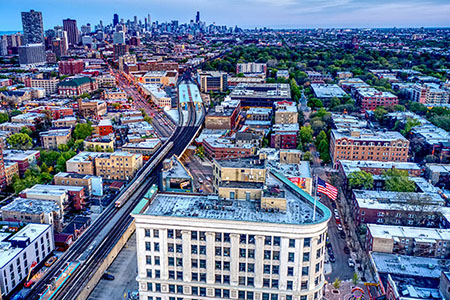
February 15, 2026 — The Near North Side neighborhood once infamously known as the Cabrini-Green public housing “ghetto” is at a crossroads.
Despite the Chicago Housing Authority’s semi-successful effort to recreate Cabrini-Green-type affordable housing on CHA-owned land in what today is considered by nearby residents as “South Old Town,” market demand for luxury residential units continues to blossom in what is rapidly emerging as the new “Gold Coast West” district.
The latest luxury development to emerge is a gut-conversion of the former Wayman African Methodist Episcopal Church, 509 West Elm Street at Cleveland Avenue, in the heart of what once was Cabrini-Green.
Seven luxury, contemporary-style condominium units, priced from $1.05 million to roughly $1.4 million including parking, are being built in-between the 12-inch-thick walls of the stately brick and limestone building, according to developer Ed Janusz, a partner in Cabrini LLC.
The Cabrini partnership group purchased the building and its expansive 2.72-acre site for about $1.28 million in 2023 and now is completing the condo.
“It’s a beautiful church we should keep,” Janusz told Crain’s Chicago Business. The development also will include a nearby new-construction building planned for rental apartments.
Sales are now underway on the two-level condos designed by Hanna Architects. Units feature balconies with views both north and south, or a rooftop deck, noted co-brokers Michelle Browne of @properties Christie’s International Real Estate and Joanna Olszynska of Compass.
The condos showcase more than 2,000 square feet of living area, engineered white oak flooring, glass staircase railings, and extra-long kitchen islands.
Browne noted that Near North Side and Gold Coast luxury condos built since 2020 have asking prices starting at about $1.7 million, or about 20 percent higher than the church units.
The vintage church building features many arched and tablet-shaped windows that add light and distinctive architectural character to the units.
Built in 1889 as the First Swedish Baptist Church, the building spent a century as the home of “Wayman AME Church” beginning in 1920. After Cabrini-Green was developed in the 1940s and 1950s, church members mostly were CHA residents.
Scaling up: Three projects reimagining the Near North skyline
Apparently, several North Side developers see the area immediately west of the former Cabrini-Green as the emerging Gold Coast West district. Here are details of three proposed projects:
1415 North Dayton Street. The 28-story tower is planned at the intersection of North Dayton Street & West Evergreen Avenue, just west of Halsted Street. The project is a partnership between Honore Properties and Peerless Development, both of which co-own the existing four-story timber loft currently on the site. The property would utilize the development rights of three surrounding parcels to upzone the site.
The high-rise would be anchored by a five-story podium clad in gray brick and is set to contain over 100 parking spaces. Above this would be a large inset amenity floor connected to an outdoor deck, with the tower suspended above.
The $145 million project still needs city approval. The developers hope to start construction in fall of 2026, with a projected spring 2028 completion.
1333 North Kingsbury Street. This 23-story high-rise (above) at the corner of Kingsbury & Halsted Street will feature 272 apartments, including 55 affordable units.
A garage will provide parking for 238 cars. Developers are Structured Development, LLC, and ZSD Corp.
Ironically, these new four new luxury developments are not the first private developer efforts to build and redevelop on the edge of Cabrini-Green. In 2000 and 2001, the 261-unit North Town Village, at Halsted & Evergreen Streets, was an experiment with a new concept called “mixed-income housing.”
The seven-acre development – consisting of a mix of rental apartments, condos, stacked duplexes, coach houses, and townhomes – was only a stone’s throw from the still-standing Cabrini-Green, and back then North Town Village received mixed reviews. Finally, in the mid-2000s, Cabrini-Green was razed in stages.
Rebirth or relapse? The CHA’s high-stakes gamble
Despite all the fancy new private developer plans for the South Old Town-Gold Coast West neighborhood, the CHA is planning the “rebirth” of Cabrini-Green on the same land where it failed decades ago.
The CHA wants to build 4,080 new affordable units on vacant Cabrini-Green land south of North Avenue, and not all units are proposed as low-rise buildings and row houses. Infamous high-rises and mid-rises are part of the plan. Most are affordable housing units and likely will include hundreds of Section 8 units.
The new “finalized master plan,” which the CHA says it will soon start implementing, essentially repeats the great 1950s landmark public housing boondoggle drafted by planners at the request of Mayor Richard J. Daley, who falsely believed that stacking poor people in high-rises would solve the city’s slum housing problems.
Today, clustering thousands of new CHA units on extremely valuable land will likely increase crime and set safe, market-rate and mixed-income residential development back another century.
This writer believes the only sane way to develop affordable housing in Chicago is to mix and sprinkle low-rise units in every city neighborhood.
The billion-dollar Cabrini-Green II real estate needs to be marketed for its highest and best use. Sell it at top prices to luxury housing developers, and builders of market-rate apartments and affordable units. Only 20 or 25 percent of this land should be developed for Section 8 housing.
If the land were sold at appraised prices today, imagine how many thousands more Section 8 units could be developed and scattered in other city neighborhoods that are seeking affordable housing.
If the CHA wants to forever hold title to this land – which is worth its weight in gold – then the organization could lease it to developers for 99 years, which has been successful in similar lower density developments in the area.